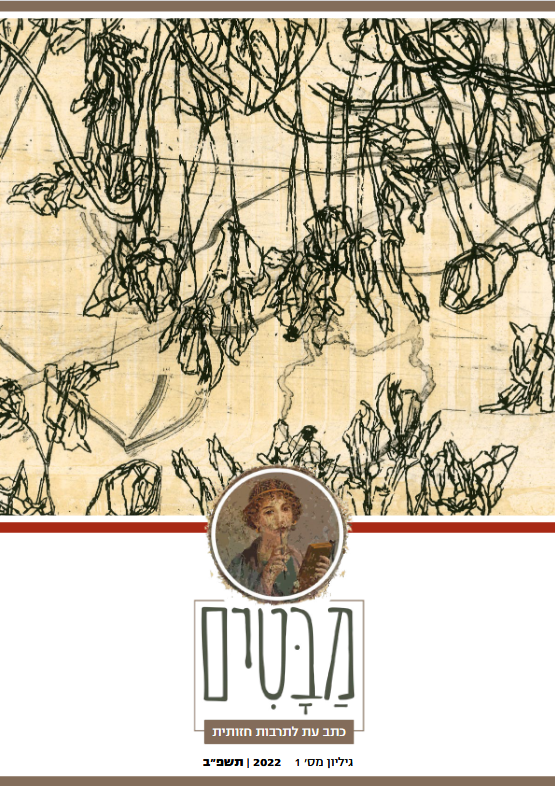
The “Print Art” of Sharon Poliakine, Hila Ben Ari, and Dorit Ringart
DOI:
https://doi.org/10.64166/8v8j3k32Abstract
Poststructuralist scholarship on the print medium identifies the process of printing with standardization and mechanism, characterizing print editions through seriality and repetition. The discourse that emerges from this perspective focuses primarily on the tension between original and copy, often overlooking the material specificity of the art object and the embodied presence of the practitioners. While this position is conceptually powerful, it misses the physical aspects of the workshop. In contrast, the present study examines the specific working conditions of etching as formative influences on the artists’ modes of thought and bodily experience in ways that transcend disciplinary divisions. I define the works of Sharon Poliakine, Hila Ben Ari, and Dorit Ringart as “print art,” and demonstrate how a profound internalization of printmaking procedures is evident even in works that do not conform to conventional definitions of the medium. I argue that the circular and horizontal movements of the press, the pressure exerted in its operation, the contact between paper and plate, and the transformations both undergo are not merely technical conditions but also fertile ground into which the artists channel their worlds of meaning.
Downloads
Published
Issue
Section
License
Copyright (c) 2022 Mabatim

This work is licensed under a Creative Commons Attribution-NonCommercial 4.0 International License.

Copyright notice
The article is an original work, created solely by the author, and has not been previously published, in whole or in part, in any journal, book, or other publication, whether in print or online, in an academic or any other context.
The article is not under review, consideration, or submission to any other journal or publisher.
Copyright in the article is held by the author.
The article does not contain obscene, defamatory, libelous, or otherwise unlawful material, nor does it infringe upon privacy rights, and to the best of the author’s knowledge does not violate any applicable law.
Publication of the article does not constitute an offense or violation of any law and does not infringe upon the rights of any third party, including intellectual property rights and copyrights of any individual or entity.
Full and exclusive responsibility for securing written permission to use any visual materials not owned by the author rests with the author.
The author bears full and exclusive responsibility for the content of the article. The journal Mabatim shall bear no responsibility in cases of plagiarism or any other infringement committed by the author.
The author undertakes to indemnify and hold the publisher harmless against any damages, losses, expenses, or payments (including legal costs and attorneys’ fees) arising from any claim, demand, or legal proceeding related to the content of the article.
The author acknowledges that any transfer of copyright must be executed in writing between the journal Mabatim and the author.